Investigating an isolated, globule-shaped object near the massive Cygnus OB2 cluster, ‘Proplyd #7’ represents a peculiar case study for understanding photo-evaporation and disc evolution in massive star-forming regions. The velocity-resolved [OI] 63 µm observations (which are one of a kind!) were obtained using the upGREAT heterodyne receiver aboard SOFIA, complemented by archival [CII] 158 µm data and IRAM 30m mid-J CO observations. By analyzing the observed velocity structure and line profiles across the proplyd-like object, we identify a velocity gradient from west to east and detect a red-shifted wing component at ~13 km s⁻¹, suggesting either disc-driven outflows or radiation-induced gas dynamics.
Through [OI] and [CII] line analysis combined with radio continuum observations from GLOSTAR, we determine that the central source is most likely a massive star with a thermal HII region, rather than a T Tauri star as previously suggested, but future follow-up studies are needed.
Using KOSMA-τ PDR modeling and non-LTE calculations for the observed line intensities, we reproduce the emission in the quiescent tail region with an external UV field of <350 G₀ and densities of 10⁴ cm⁻³. However, the model fails at the YSO position, where the elevated line widths and intensities across all tracers indicate additional heating mechanisms beyond simple PDR chemistry, potentially from shocks or internal radiation.
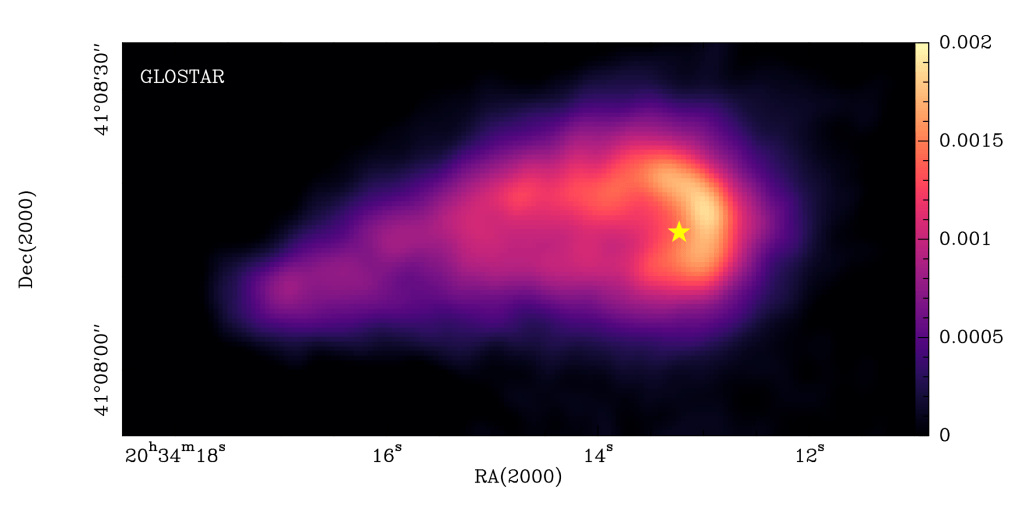
Furthermore, while the calculated photo-evaporation timescale (1.6×10⁵ yrs) is shorter than the free-fall time (5.2×10⁵ yrs), the object has already survived UV exposure for ~4.5×10⁶ yrs, suggesting that external photo-evaporation alone cannot explain the structure and evolution of Proplyd #7.
This work (led by Nicola Schneider) highlights the complexity of interpreting compact ionized regions embedded in molecular envelopes, where distinguishing between disc-related and envelope-related emission remains challenging even with velocity-resolved far-infrared observations.
It also highlights the urgent need for further observations of proplyds (there is some ambiguity in using this name which is thoroughly discussed in the paper) in regions other than Orion. While for some time, after the shutdown of SOFIA, no follow-up observations of the important FIR cooling lines in galactic environments will be possible, this study embraces the need for future capabilities in this wavelength regime.
 Kreck Observatory